
The Shakespeare Monkey
A Book by Book Account

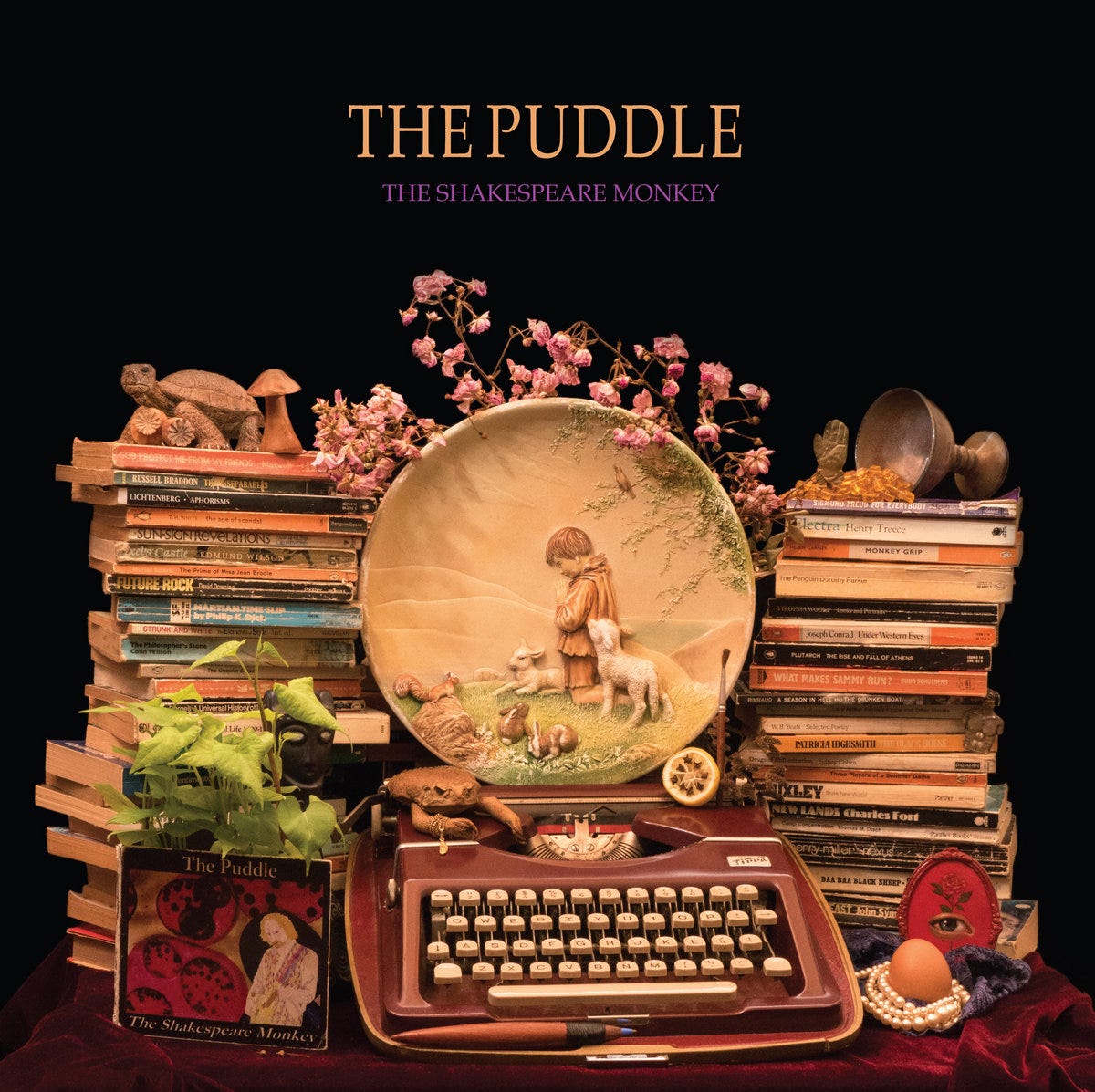
The Shakespeare Monkey, a 2009 album by The Puddle that drew a heartening amount of positive press at the time, who cares that The Wire hated it, has been reissued, slightly abridged, as a vinyl LP by Fishrider Records; you can buy it via Bandcamp below, or at most good record stores (including World of Echo in the UK).
When Hayley Theyers, back in 2021, created that wonderful image on the LP’s cover, we grabbed some books from the many, too many some might say, stacked about our house. A lucky dip of the recently-reads or looked-ats near the top of our many piles for the most part, not necessarily the very best or most favourite titles, let alone the coolest of performative reads, but all well worth reading for one reason or another, together with a selection of the objects and artworks around our place, a collection that Hayley, being the painstaking artiste that she is, built up and photographed over six sessions until her tableaux was perfect. The 2009 Shakespeare Monkey CD cover on display was designed by Ian Henderson of Fishrider records, who also made this reissue possible, the painting at lower right is by Sophie McDonnell, one of many talented members of the Greig family, the cane toad was a gift from Chloe in Australia, and the typewriter, which was lent to me by Stuart Page, originally belonged to photographer Larence Shustak, who Stu tells me was born on the 13th February 1926, exactly 100 years before this album’s official release date. The plate is my christening plate, and the motto on it - “he prayeth best who loveth best all things both great and small” - is not the quote from The Rhyme of the Ancient Mariner.
Here’s the official video for track one ‘As It Was’, made by Hayley recently by manipulating images from her mediaeval archive with Grok AI animation. She shows us that this dystopian technology can, for now, be used to bring to life something that’s very personal and human.
And here are those books, reviewed.
God Protect Me from My Friends
Gavin Maxwell (1956)
Maxwell was an adventurer of independent mind who travelled to difficult places; getting to know otters when living with the Marsh Arabs in Iraq he wrote the classic nature book Ring Of Bright Water. This early journalistic work tells the story of the Sicilian “people’s bandit” Salvatore Giuliano, killed in 1950 after many battles with the police; it’s also the story of a poverty-stricken and lawless land and its people, incredible to think this is Europe. In the book Maxwell implicated two Italian politicians in the 1947 May Day massacre of 11 communist Sicilians and their families celebrating an election victory, which Giuliano took credit for, after which his time was up with the Sicilians. The politicians sued him and both won; Maxwell narrowly avoided a 8 month prison sentence. His own political views were mystical, reactionary and pretty much unique to his long-gone type.
The Inseparables
Russell Braddon (1968)
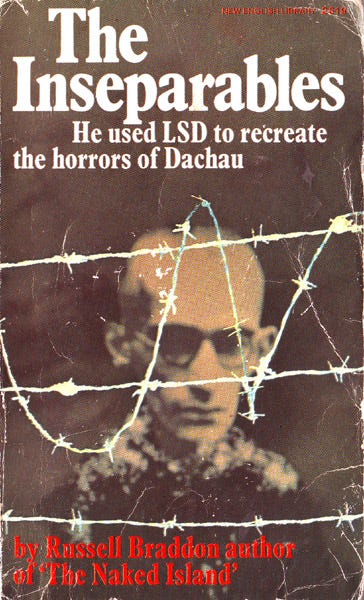
Russell Braddon was a British journalist who had survived imprisonment in WW2 by the Japanese, an ordeal which he described in The Naked Island. He also wrote The Night of the Lepus, a sci-fi horror paperback about giant rabbits which was turned into a film. In The Inseparables Erich, a troubled young German whose father might be have been in the SS, takes LSD and goes to visit Dachau. In his altered state, he’s able to see the ghosts of four of the camp’s former inmates. The doctor among these four friends asks him why he took such a drug.
'For kicks!' Peevishly, as if the question was ridiculous. The German newspapers were full of stories about psychedelic clubs, way out students, stroboscopic lighting, joss sticks, hash, pot, being turned on, dropped out, groovey, hippies, ravers, and acid – the whole paraphernalia of the cult that allegedly had swung in London, flourished in California and now was rearing its horrid sexy head even in West Berlin – and this doctor, of all people was pretending to know nothing about it.
In this book, written in 1968, we have the premise of Baader Meinhoff and Krautrock.
Aphorisms
G. C. Lichtenberg (1800)
George Christoff Lichtenberg (1742—1799) was a Prussian philosopher back when that also meant scientist, or a physicist back when that meant philosopher. Hunchbacked and tiny, the result of a childhood accident, Lichtenberg discovered the fractal patterns of lightning, developing the ideas of Benjamin Franklin in ways that are still used today, but he also thought about human nature and the nature of reality. His aphorisms include wry reflections on his own defects, generalizations of mass psychology, impressions of foreigners and foreign cities he’d visited or had news of, and observations on science and art. There’s something unassuming about Lichtenberg’s dicta, and his jokes, which still go off today, and he writes about his times like a visitor from the future, making this my favourite collection of pensées.
If you ask him for the time, he tells you how the clock was made.
What if the sense of free will is just the awareness that the mechanism happens to be running perfectly?
It is a pity we cannot see the learned entrails of a writer so as to discover what he has eaten.
The Age of Scandal
T.H. White (1950)
White wrote the Arthurian novel The Sword In The Stone, and the sequels which together make up The Once and Future King, the fantasy epic which might be considered the Marxist-historical equivalent of the High Church Tory-ism of The Lord of the Rings. A teacher and a definite oddball, like seemingly most of the authors on display, White has here written the most lurid, tabloid, Mondo Cane account of the 18th Century that it was possible to publish in 1950. Tales of the Hell Fire Club, abducted heiresses, mad Kings and adulterous Queens, as well as some truly horrible pirates, are topped off with a somewhat sympathetic portrait of the Marquis De Sade.
Sun-Sign Revelations : An Unusual, Practical, Revealing, Unflattering, Lighthearted Astrological Guide to the Perverse Personalities of our Friends, our Enemies, our Lovers, and Ourselves
Marie Elise Crummer (1975)
In Dunedin, circa 1989, I was living, with several others, in a flat that received a weekly community paper. In this paper there was always a fairly studious-seeming horoscope for the coming week. For some reason we fell in the habit of reading the horoscopes at the end of the week, and we liked to be impressed by how well the predictions had matched the experiences of each Pisces, Libra, Scorpio and Gemini. So far, so good. One Sunday morning, I was reading the past week’s horoscopes to my increasingly baffled crew, and became disturbed by what I had read. “This is the wrong horoscope! They’ve printed the wrong one!” I could be heard complaining about this for days. Two weeks later, the paper published an apology with the horoscope; the wrong horoscope had been printed that week. Sun-sign astrology and the astrological birth chart, what my son calls birthday racism, are as useful as any other psychological scheme for viewing subjectivity and theory of mind. This entertaining book gives only the bad news about each of the 12 zodiacal signs. Bad Astrology, you might say (also available on vinyl).
Axel’s Castle
Edmund Wilson (1931)
Wilson’s study of the problems of late-romantic and early-modern Symbolist literature is a classic of criticism; Wilson was Vladimir Nabokov’s pen-pal, and perhaps victim (some think his Memoirs of Hecate County is being satirized in Lolita), Mary McCarthy’s husband, and a thinker Dorothy Parker quoted with approval. He was a fellow traveler for a time, and in To The Finland Station gives us Marx and Marxism’s place in the history of ideas, Wilson attune to the implications of language and how Marx’s choice of words might distort his message. Axel’s Castle tells us how dreams take dream-like form, To The Finland Station, how they begin to turn into nightmares.
The Prime of Miss Jean Brodie
Muriel Spark (1961)
Muriel Spark’s most successful novel, the one made into an unforgettable film starring Maggie Smith, is the story of an inspired teacher and the influence she has on a group of girls she takes under her wing. The story, which is recognizably set in the city of my birth, sparkles with Scottish wit and sexual mystery, which will be Miss Brodie’s downfall, but it’s fascism that’s really the Devil in disguise; this admirable teacher’s worship of art and beauty, virtues she connects with Italy’s noble past, leads her, and those who adore her, astray. Walter Benjamin said that all efforts to render politics aesthetic culminate in one thing: war. The Prime of Miss Jean Brodie shows that rendering aesthetics political can have much the same result.
Future Rock
David Downing (1976)
How cool is it, that before I started this stack, the only music-related book in the picture was David Downing’s sole attempt at rock writing, a 1976 summary of futurist trends in prog, glam, metal, krautrock, art rock, and so on? Essential reading for rock critics I would think because Downing is trying to define the constraints and possibilities of a novel, cross-genre ethos, because his view of the late-60’s-early-70’s period is forming too early for any revisionist tendencies to creep in, and because of prose like this, about how the songs of Syd Barrett differed from other works of psychedelic whimsy:
What provided the bite in Barrett’s, making them more than just nice sounds evoking pretty childhood stories, was the undertow of terror, barely visible in the written word, but all too audible in the enunciation and delivery.
Martian Time Slip
Phillip K. Dick (1964)
Not my favourite Dick book - that would be Now Wait For Last Year (drug morality), or Clans of the Alphane Moon (mental illness ftw), or The Penultimate Truth (wake up sheeple!), or The Man in the High Castle (Nazi vs Japanese aesthetics) - but the first I read, recommended to me by Lindsay Maitland in the little second-hard paperback shop South of the tracks in Invercargill. Fried on speed, Dick projected his real-life paranoias into timeless fantasies that predict every possible variant among our incipient dystopias. But they also have a vibe, a heart of sympathy that’s rare in sci-fi, and the everyman characters at the centre of his stories, struggling to stay afloat in their tech-and-misinformation economies, make them fairy tales of the proletariat. Various books about Dick are also compelling, the man was complicated.
The Elements of Style
C.S. Strunk and E.B. White (1959)
My laugh-a-minute copy of Fowler’s Modern English Usage came as a bulky hard cover, so this slimmer but equally amusing US equivalent stands for all style guides. It’s not that I’ve ever felt I needed a style guide, though no doubt I still do, it’s more that I appreciate their underplayed humour. There’s no humour in Grammarly or ChatGPT, and awareness of humour is the essence of tone, even if you’re writing a tragedy — to quote Iris Murdoch (in The Black Prince), “language laughs in its sleep”.
The Philosopher’s Stone
Colin Wilson (1969)
Alas, this is not the edition with a foreword by Joyce Carol Oates, but it is a typically inspiring Wilson novel-of-ideas, and one of three he wrote inspired by H.P. Lovecraft’s mythos, in this case, his Elder Gods. I own dozens of Wilson’s books, which I treasure for their lucid, scientific style, Wilson’s pragmatic approach to psychology (a friend of Abraham Maslow, Wilson popularized some core concepts adopted by modern psychotherapists), his let’s-try-this-at-home version of existential philosophy, his attempts to understand the occult, and what Oates would later call a “speculative-prurient” approach to the subjects of sexual aberration and violent crime.
The Unquiet Grave
Palinurus (1944)
Palinurus was the pen-name of Cyril Connolly, English man-of-letters, editor of journals, and essayist. The Unquiet Grave is a curious patchwork of aphorism, allegory, autobiography, self-examination, with many quoted (or invented?) Ancien Régime aphorisms left, frustratingly, in the original French. Evelyn Waugh used to mock the confusion of Connolly’s parlour socialism, and you can see why right there. The book’s saving grace is the way it blends such mandarin literary aesthetics with sagas of personal futility, and the bizarre way Connolly has chosen to tell his story.
Kim
Rudyard Kipling (1901)
To diminish Kipling for being the Poet of Empire would be to miss the point of much of his work. Kim, like The Jungle Book, is an escapist novel about childhood, which was an unhappy time for its author, a clever spy story set in the Great Game, and, like much of Kipling’s work, a sentimental success, but in it Kipling also sees (or rather, remembers) something about India, its situation, its peoples, its geography, its philosophies, and how they all work together to create something special, that he wants his countrymen to see. He can be seen as fabricating an Indian identity for home consumption, but others would follow, because identity is a step towards independence.
I think of Kipling as a very great writer. Kipling, I suppose, was Hemingway's master. Only Kipling did it better. — Jorge Luis Borges
A Universal History of Infamy
Jorge Luis Borges (1935)
It’s Borges, not Orwell, Huxley, Dick et all, who predicted what it’s going to be like living with Artificial Intelligence, in stories like ‘The Circular Ruins’, ‘Pierre Menard, Author of the Quixote’, and ‘The Library of Babel’, where dream gets confused with reality, the copy has a valid claim to be an original, and the alternatives to truths gradually become indistinguishable from them. In The Universal History of Infamy, Borges unreliably recounts the lives of some villains, famous, obscure, and invented. Today your search engine can do that, certainly, but it won’t do it in such style. Angel Flores dated the start of the magic realism movement from the publication of this book.
Capitalism and Material Life, 1400-1800
Fernand Braudel (1973)
It’s all very well to know your history, or the novelistic recreations of it, but do you know what peasants and armies were eating, or how much they earned and what they spent it on, in, say, 1500? What passes for leftism in the modern day is woefully detached from material reality, indeed often in quixotic combat with it. Why did Marx even bother. If you want to keep your historical feet on the ground, this is a good place to start. Did you know that the reduction in the labour supply caused by the Black Death caused wages to increase so much that workers could afford to eat meat at every meal for the next hundred years, what Braudel calls the carnivorous century? Statistics, and some excellent infographics, have never been made so interesting.
Sigmund Freud for Everybody
Rachel Baker (1955)
Baker is a Freudian, and Freud was a bit of a cult leader, so the treatments of Jung and Adler in this book are as you’d expect, but don’t just dismiss Freud’s mad schema in favour of more consoling (Jung) or practical (Adler) ideas, he is the poet of the modern soul, right even (especially?) when he’s wrong. Once you know his theories, and how they were received, you’re going to get a lot more out of 20th century literature and film, because everyone who was anyone in the last 100 years was steeped or or opposed to his ideas. That so many great thinkers have rushed to debunk him, as people insist on debunking Shakespeare, is simply a measure of Freud’s greatness. That said, if you insist on being your own psychoanalyst, taking on a fool for a patient, it’s probably safest to start with Adler and Jung.
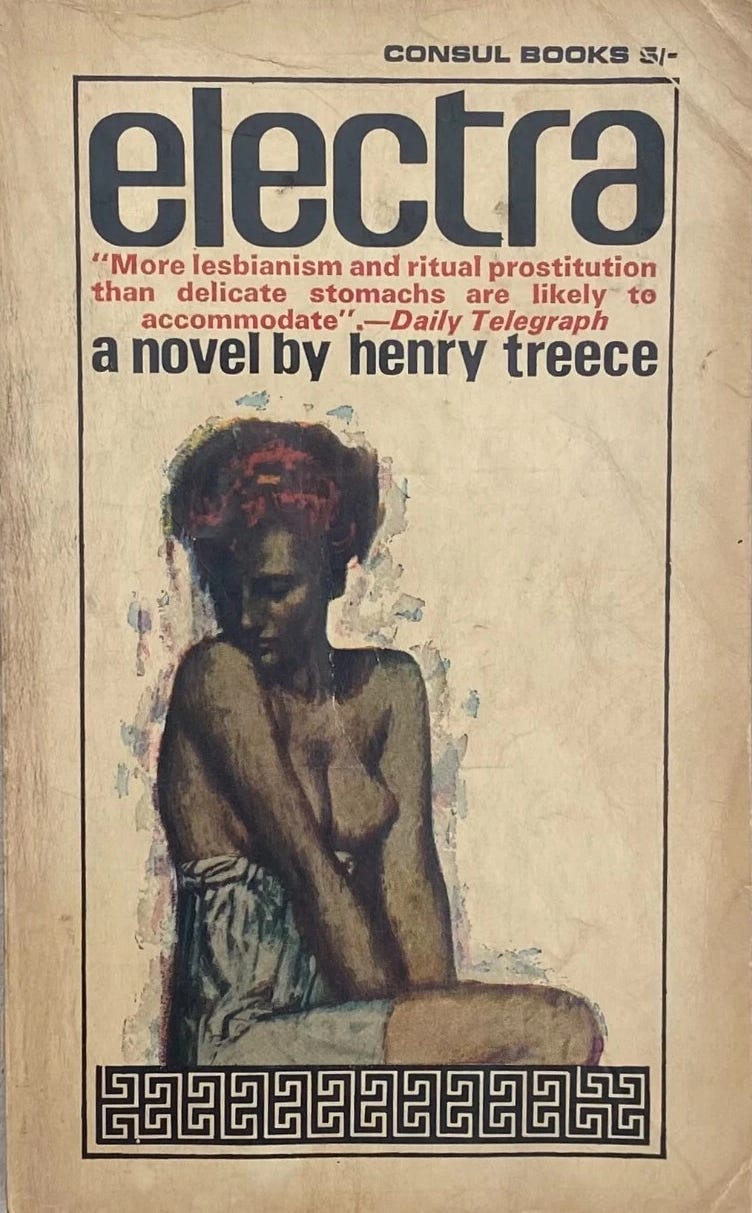
Electra
Henry Treece (1963)
No-one has recreated the sounds and smells and religious sense of the ancient world like Treece does. It’s like he’s really been there, you can taste every apple and barley loaf, and feel the heat-filled air. Electra is one of three Henry Treece titles set in mythical Greece, the others being Jason and Oedipus. Pace Freud, Electra’s desire is simply to respect her lost father. And to serve the Goddess, because Treece’s Electra is a Minoan girl in a Mycenean world.
Monkey Grip
Helen Garner (1977)
Garner’s story of a young solo mother in love with a junkie on the Melbourne bohemian fringe is semi-autobiographical and packed with non-sensationalized, unromanticized details of day-today reality, which is not to say that her telling lacks poetry, just that it’s the poetry of fleeting moment of happiness, comfort or rest, and of (mostly) ordinary hardships made a little worse by fecklessness. I could have put, say, William S. Burroughs or Thomas de Quincey in these piles, but this is a book that better reflects the world I’ve lived in, and it’s the view from the other side, the one that long-suffering straight partners of junkies get to see. In Monkey Grip, Nora has casual work in the Melbourne film industry, but in the pretty good 1982 film of the book it’s the music industry, and she’s working with the Divinyls, and Chrissy Amphlett co-stars.
The Penguin Dorothy Parker
Dorothy Parker (1977)
Dorothy Parker lived, in an alcoholic haze, until 1963, but she’ll always be associated with the 1920’s and the jazz age, which is almost a pity, because her sensibility is timeless. She practically invented the refined wisecrack and the meaningful aside, and that “meaningful” is why she’s much more than just a great print comedienne and the poet of disillusionment. This edition collects many of Parker’s New Yorker book reviews, published under the pen name Constant Reader, including a review of The Journal of Katherine Mansfield, “a beautiful book and an invaluable one”, but one so intimately revealing as to leave her feeling uncomfortable, several of her short stories about jazz age femininity, and a collection of poems; more of these should be set to music, like ‘I Wished On The Moon’, a popular 1935 collaboration with Ralph Rainger, recorded by Bing Crosby and Billie Holiday among others, and ‘Threnody’, a setting by Per Gessie that appeared on the 1982 solo album by Frida from ABBA.
Books and Portraits: Some Further Selections from the Literary & Biographical Writings
Virginia Woolf (1981)
I’m not a fan of Woolf’s novels, but give me an intelligent writer’s reviews and essays and I’m always happy, and Woolf was as smart as it gets. And this collection is full of the most brilliant prose, often in the service of the humblest of topics. Here’s her description of bad writing - “But then – what is it? Something bald and bare and glittering – something light and brittle – something which suggests that if this precious fruit were dropped it would shiver into particles of silvery dust like one of those balls that were plucked from the boughs of ancient Christmas trees, and slipped and fell.”
You can drop this book, and pick it up again.
Under Western Eyes
Joseph Conrad (1911)
Conrad, whose own father had been imprisoned by the Russians for stirring for Polish independence, lived in a time of revolutionary ferment, and understood the essentially inhuman consequences of terrorism and counter-terrorism. The hero of Under Western Eyes is an apolitical young student caught up in an assassination plot not of his making who betrays his friend, and ends up used by the authorities, and entangled with revolutionaries he never wanted anything to do with. Its moral complexity reflects Conrad’s reading of Crime And Punishment and his own guilt over deserting his homeland; while writing it Conrad suffered a weeks-long breakdown during which he conversed with the novel's characters in Polish. In Conrad’s earlier novel The Secret Agent (1907) a simple-minded lad is tricked by his sister’s double agent husband into carrying a bomb that blows him to bits. Both books were based on real events.
The Rise and Fall of Athens
Plutarch (circa 100 AD)
Plutarch’s Lives of nine archaic Greek leaders, taken from the work known as Parallel Lives. The original paired the life story of 23 men from the Golden Age and prehistory of the Greek city states, the most modern of whom died 300 years before Plutarch’s time, with 23 men from Rome, in Plutarch’s time riven with civil war due to the takeover of the Roman Republic by demagogues, dictators and corrupt businessman. The Fall of the Roman Republic selection was already familiar stuff when I read it in 2016. The Greek volume is less depressing, the stories include the story of gay icon Alcibiades (did he or didn’t he? Freud should have named a syndrome after Alcibiades), and the legendarily wise and balanced statesman Solon, the man who overturned the draconic laws of Draco.
What Makes Sammy Run?
Bud Schulberg (1941)
One of the great novels of old Hollywood, the other being Nathaniel West’s Day of the Locust (1939). Bud Schulberg was an admirer of Scott Fitzgerald, and wrote the novel The Disenchanted after accompanying the older writer on a disastrous, drunken trip to receive an honorary degree from his Alma Mater. The story of What Makes Sammy Run resembles The Great Gatsby somewhat - Sammy Glick, a Hollywood player with obscure origins, backstabs his way to the top, and the narrator is the link to his past. Goldwyn and Mayer both hated the book and tried to suppress it, on the grounds of antisemitism (Sammy is Jewish, like most of his victims) and a high-ranking Communist Party of the USA member demanded that Schulberg make substantial changes to reflect Communist principles. Instead, Schulberg refused, quit the party in protest, and a decade later testified against his former comrades before the House Unamerican Activities Committee.
A Season in Hell and The Drunken Boat
Arthur Rimbaud (1873, 1870)
When it comes to poetry, I care only for the very best. Arthur Rimbaud (1854-1891) was a child prodigy, and his early poems are technically perfect, vivid and fragrant, flowers of poesy that mock their Parnassian models with the insertion of naturalistic subject matter. Joyce will pull a similar trick in Ulysses. The Drunken Boat (1870) is the culmination of this period, a giddy, brilliant, quotable dream to entrance and inspire future surrealists. Disillusioned after hitch-hiking to Paris to join the Commune in 1871, Rimbaud stayed home and experimented with altered states, and wrote his visions into increasing modern verses. After going to Paris, seducing the older poet Paul Verlaine, behaving abominably in literary society, and maddening himself further with drugs and drink, Rimbaud took Verlaine to London and wrote A Season in Hell, a collection of visionary prose poems. After one more set of prose poems, Illuminations, Rimbaud, then 20, and by now having shot and slightly injured Verlaine at a train station, quit poetry altogether and went to the Horn of Africa, where he did some firearms, coffee, and possibly slave trading, returning to France and dying at the age of 37.
The Flight From The Enchanter
Iris Murdoch (1956)
This is, I think, the slim volume we can’t see under Rimbaud, and it’s one of those “books that changed my life”. It’s Murdoch’s first novel, though it wasn’t published until the success of Under The Net, which is told from a man’s point of view. The Flight From The Enchanter sees the world from a female point of view in a way that no other Murdoch book does; the men in it threaten and attract, the heroines move around them carefully, managing their own desire, sometimes letting it run a little too far. Reading The Flight From The Enchanter before lockdown convinced me that the feminine point of view and yet-undiscovered examples of female creativity could become a new source of lasting interest, and so they are.
W.B. Yeats
Selected Poetry (1990)
Yeats is a lyric poet per excellence, and I’ve set his words to music (which as far as I knew was illegal without his family’s permission but I thought a lawsuit would get me publicity) twice for The Puddle; ‘The White Birds’ on Into The Moon, and ‘A Drunken Man’s Praise of Sobriety’, which we performed live in the 90’s but only made it into the world on Late Romantics: George Henderson Plays the Jen Brio P-49 Organ in 2021. I’ve also set Under Ben Bulben to the tune of Alex Chilton’s ‘Alligator Man’ - try this, it’s an excellent fit. Yeats was the man, and Auden, the next man, was wise to supplant him with that wonderful eulogy.
The Black House
Patricia Highsmith (1981)
I picked up a second-hand Ripley Underground, the second of Patricia Highsmith’s five Ripley books, and was hooked. Highsmith taps into the reader’s own sense of guilt to make us identify with her antihero Tom Ripley - it’s knowing what he needs to hide to hold on to his fake bourgeois life that pulls us in, because it parallels our deepest insecurities. Highsmith’s sense of panic is understated, deadpan, suffocating. The past being what it was, Highsmith had her own secrets. The fourth Ripley book, The Boy Who Followed Ripley (1980), is essentially an extended review of Lou Reed’s Transformer in novel form, and a celebration of queer culture coming out, with the sad note that it may be too late for Tom. Little Tales of Misogyny (1975) is a sui generis masterpiece, whether of feminism or misogyny, who can say.
Drugs of Hallucination, the LSD Story
Sidney Cohen (1970)
When I was 18 or so I took some weak purple haze LSD, allegedly, and listened to ‘Purple Haze’ on a friend’s 8-track car stereo. It sounded different, more physically present perhaps. When I was twenty, I dropped a couple of proper tabs and listened to ‘Interstellar Overdrive’ at high volume for hours. I was at the beach, there was no stereo, just the crashing of the waves. The 60’s scientific literature on psychedelics is surprisingly good, and most of the uses we have today (MDMA and couples counselling, ibogaine and addiction) were discovered then. Then research was banned for half-a-century, giving the underground its unique perspective. This is a popular summary of that science.
Three Players of a Summer Game
Tennessee Williams (1960)
Tennessee Williams is the great 20th century playwright, no-one comes close. And there are so many great films of his work. This is a collection of short stories, and includes the idea that became John Huston’s The Night of the Iguana. Everything about William’s world teeters on the borderline of hysteria to an extent that would terrify Freud; the gay eye for the feminine management of chaos was never sharper, his women are usually pathetic dreamers or terrifyingly disillusioned but never take second place to the men, who are all shades of impotent or brutish. Interestingly the first writing Williams published was an ornate fantasy piece in the style of Clarke Ashton Smith, which is to say, of the school of H.P. Lovecraft. And maybe it’s a note of cosmic horror, from witnessing his sister’s madness, that makes his characters loom so large.
Brave New World
Aldous Huxley (1932)
Why is there still no film of Brave New World? The downbeat ending could be skipped, and the way Huxley has modernized his own early 30’s world, so that the technology of his future is often outdated by our standards (what’s been called valvepunk), is surely the type of design challenge that Terry Gilliam would take in his stride. ‘Hug Me Till You Drug Me, Baby’ - Huxley, elitist that he was, hated pop music, indeed said the au courant racist and antisemitic things about it before he moved to the USA, and in Brave New Word, poptimism is one of the future dystopia’s greatest horrors. This is a man, who, the first time he tried mescaline, put on one of Mozart’s records, found it too commercial, took it off, and put on Gesualdo.
But Lenina and Henry had what they wanted... They were inside, here and now--safely inside with the fine weather, the perennially blue sky. And when, exhausted, the Sixteen had laid by their sexophones and the Synthetic Music apparatus was producing the very latest in slow Malthusian Blues, they might have been twin embryos gently rocking together on the waves of a bottled ocean of blood-surrogate.
New Lands
Charles Fort (1923)
Charles Fort kept newspaper clippings of reports of unexplained phenomena from all around the world and published them in these themed collections, long before weirdness was cool. One of the many things that can be learned from Fort’s collections are, that UFO’s were first described as balloons, and their inhabitants as balloonists, when balloons were new and rare, and later as rockets in the early days of rocketry, before assuming today’s more sensible saucer-shaped design. New Lands is mostly reports of other worlds, seen in the sky or through holes in the earth.
Camp Concentration
Thomas M. Disch (1968)
One of my favourite Sci-Fi books not by Phillip K. Dick; some conscientious objectors in a future-war concentration camp are used as experimental subjects to test a nootropic but rapidly lethal variant of syphilis, based on the disease’s supposed historical connection to genius. I haven’t read this since I was a kid, but the premise grabbed me, the exposition is an education, and the development, as I remember it, worked fine. Makes an interesting companion to The Inseparables. My other non-Dick favourite was Norman Spinrad with The Void Captain’s Tale (space sex) and The Iron Dream (Hitler’s sci-fi novel). And then there’s Bug Jack Baron, which invented Q-Anon. All these books, except maybe that last, should be made into films.
Nexus
Henry Miller (1959)
If George Orwell hadn’t known Henry Miller, 1984 would have told a different story. Miller was the first pornographer since the Marquis de Sade to earn a serious reputation, because, to quote the New York Times announcement of the 1968 French decision to lift the censorship of his works, "Miller uses licentious sex scenes to set the stage for his philosophical discussions of self, love, marriage and happiness.” Nexus is the final volume of the 3-part autobiography of the author’s early years in New York, in which the sexual mystic’s open marriage to one woman closes on him as he meets his next wife, June, who accompanied him to Paris, where he wrote and published the works that made him famous. There he met Anais Nin, a like-minded soul; the love triangle that resulted gave us the film Henry and June. I haven’t read Miller’s books since I was a teenager; what I remember from them is the impoverished and then-exotic Brooklyn setting, of tenements, radiators and fire escapes, and the ecstatic consummation and frustration of cloakroom encounters with taxi dancers.
Baa Baa Black Sheep
Gregory Boyington (1958)
The autobiography of America’s top naval air ace, officially credited with 26 kills in the Solomons theatre. A self-described “psychopathic liar”, “Pappy” Boyington may have corrected the official record post-war to improve his score and come out ahead, but there’s no doubt he was a great leader, a brave man, and a natural flyer and fighter. RNZAF flyers come in for a lot of praise in this book, never leaving Boyington’s men in the lurch over Rabaul as the USAAF was prone to do. I got into Boyington because of the TV series Baa Baa Black Sheep, which screened on Sunday afternoons circa 1990 and used plenty of technicolour gun camera footage from Pacific War carrier battles. Everything discreditable in his story seems to be missing from the Wikipedia page.
The Great Beast
John Symonds (1952)
John Symonds met Aleister Crowley in 1946 and became his literary executor on his death the following year. Crowley’s followers considered Symonds’ critical attitude hostile to their master and the syncretic religion of Thelema he invented, but there’s no doubt that Symonds’ work helped ensure Crowley’s place in history; his willingness to point out the Great Beast’s flaws and inconsistencies in entertaining fashion, and bring up examples of his cruelty, treachery and cowardice, ensured his story had far greater appeal than any more respectful work (Crowley’s own Autohagiography is, of course, well worth reading). The man’s life is a grand and picaresque adventure story, not for the faint hearted, and his charlatanism, bombast, contrarianism, and selfishness are on display as often as his humour and his genius. But ultimately, we end up being the recipients of Crowley’s spiritual generosity - the Thelemic system in perpetuity is an open-source religion, free for all to use and adapt, wholly unlike the cash-in travesty that was generated by L. Ron Hubbard from the ruins of LA Crowley acolyte Jack Parson’s Agape Lodge.
lol i wanna see that WIRE review
maybe the reissue will get a better one, who can resist a record that comes w/ a reading list